$ man developer — a field guide, 502 pages
The Developer Lifecycle
From Hello World to Goodbye World — the habits, habitats, and survival strategies of the modern software developer, observed in the wild through every stage of the career.
habitat : dark rooms, lit by monitors
diet : coffee, open tabs, stack overflow
status : deprecated, still in production
- 502
- pages
- 9
- life stages
- 2
- formats, DRM-free
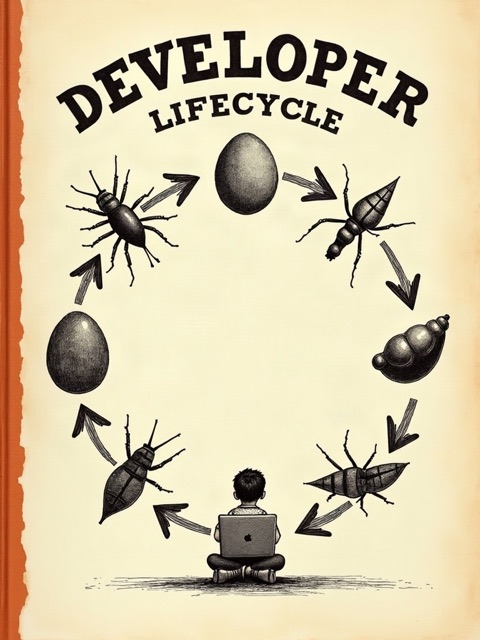
The Great Migration Path
Each developer molts through five common stages before diverging onto one of four terminal paths. Their code follows its own arc — simple out of ignorance, complex out of ambition, and, in the ones who make it, simple again out of wisdom.
v0.xThe Curious Beginner
First contact with Hello World. The euphoria of a working program. Stack Overflow's first bite.
field note · v0.x“Printing 'Hello World' takes one line of code and three days of installing Python.”v1.xThe Junior Developer
First contact with production code. Imposter syndrome manifests. Dependency hell, discovered.
field note · v1.x“The branch protection rules at your company are not policy. They are scar tissue.”v2.xThe Mid-Level Developer
Debugging instincts sharpen. Technical debt becomes visible to the naked eye.
field note · v2.x“The estimation function finally returns the correct answer: 'it depends.' The first number you say out loud becomes the deadline.”v3.xThe Senior Developer
Solution architecture mastery. The art of saying “no.” Legacy code wisdom.
field note · v3.x“After 8 years of coding, I've mastered the art of Googling things I should definitely know by now.”v4.xThe Tech Lead
Delegation mastery. Strategic planning. Calendar Tetris expertise.
field note · v4.x“Being a Tech Lead is like being a parent — you fake confidence until somehow things work out, and nobody notices you're making it up.”v5.xThe Management Track
· divergent pathThe gradual code withdrawal. Meeting multiplication. Calendar as code.
field note · v5.x“As an engineer I fixed bugs. As a manager I schedule one-on-ones with them.”v6.xThe Forever Engineer
· divergent pathDeep domain expertise. The “go-to person” burden. Niche technology dominance.
field note · v6.x“I've survived 5 CEOs, 7 CTOs, 12 reorgs, and still nobody knows how the legacy payment system works except me.”v7.xThe Entrepreneurial Exit
· divergent pathSide project scaling. MVP minimalism. From coder to CEO.
field note · v7.x“I quit my job to be my own boss. Now I have forty bosses called customers and twelve more called investors.”v8.xThe Industry Exit
· divergent pathThe great escape planning. Knowledge handover rituals. A cabin in the woods (with excellent internet).
field note · v8.x“After 20 years of debugging, I've decided to debug plants instead.”
Specimens under glass
Recovered from real codebases and lightly sedated for display. Two of the 190 exhibits inside the book.
The TODO Collection
A complete taxonomy of intentions, preserved exactly as found.
The Midnight Debugger
The nocturnal debug cycle, captured at the moment of eureka.
def sudden_realization(self): return { "time": "3:42 AM", "location": "bed", "eureka_moment": "OH MY GOD, I KNOW WHAT'S WRONG", "solution_found": True, "will_remember_tomorrow": False, }“It’s 3 AM. Your eyes snap open. The semicolon. It was missing a semicolon all along.”
The Complexity Curve
The same function, at every stage of the career. Code starts simple because you can’t do more, gets complex to prove you can, and returns to simple once you’ve stopped proving. (ch. 0.0.5)
The Beginner
101 lines// checks if a number is even. took all afternoon.if (n == 0) { even = true; }else if (n == 1) { even = false; }else if (n == 2) { even = true; }else if (n == 3) { even = false; }// ...continues to n == 100// then a comment that says "should be enough"Simple. Dumb. Works. Shipped on time, out of ignorance.
Field observations
“Deployed a distributed microservices architecture with a Kubernetes cluster to serve a static HTML page with 3 users.”
field observation no. 041 — the architecture astronaut
“In my day-to-day job, I architect distributed systems. In interviews, I forget how to write Hello World.”
field observation no. 107 — the interview gauntlet
“I don't always test my code, but when I do, I do it in production.”
field observation no. 213 — junior dev, last day of employment
“I know 20 programming languages, if you count Hello World as proficiency.”
field observation no. 007 — the curious beginner
Table of specimens
0.0.5The Complexity Curve: A Round Trip to Simplicityspecimen preview · ch. 0.0.5“The beginner writes simple code because they can't do more. The mid-level writes complex code to prove they can. The senior writes simple code because they've stopped proving.”0.1.5The Java vs JavaScript Crisisspecimen preview · ch. 0.1.5“Java is to JavaScript what Car is to Carpet.” — every CS professor, trying not to laugh0.1.7The Interview Gauntlet: Trial by Whiteboardspecimen preview · ch. 0.1.7“In my day-to-day job, I architect distributed systems. In interviews, I forget how to write Hello World.”0.1.8The FAANG Feverspecimen preview · ch. 0.1.8“In a world of ninjas, rockstars, and gurus, sometimes you just need someone who can write a for loop.”1.0.2OS Wars: Choosing Your First Environmentspecimen preview · ch. 1.0.2“In DevOps, we don't say ‘I love you’ — we say ‘it works in my environment’, which means the same thing.”1.0.3The Local Setup Saga: A Journey of a Thousand Dependenciesspecimen preview · ch. 1.0.3“Day 5 of setting up local environment: I now believe dependencies are just a social construct.”1.0.5The Dependency Hell: A Version Control Nightmarespecimen preview · ch. 1.0.5“It works on my machine!” — famous last words before npm install1.0.8The Midnight Debugger: When Dreams Debug Your Codespecimen preview · ch. 1.0.8“It's 3 AM. Your eyes snap open. The semicolon. It was missing a semicolon all along.”1.0.10The PR Review Chase: A Tale of Ghosting and Desperationspecimen preview · ch. 1.0.10“Legend says my PR is still waiting for review, much like my colleague is still ‘looking at it soon’.”1.0.13The Meeting Mayhem: A Calendar Full of Regretsspecimen preview · ch. 1.0.13“This meeting could have been an email.” — every developer, in every meeting, ever1.0.15The Code Comments Comedy: Tales from the // Sidespecimen preview · ch. 1.0.15“Code never lies, comments sometimes do.” — developer who found a lying comment2.0.19The Vibe Coding Phenomenon: Shipping Code You've Never Readspecimen preview · ch. 2.0.19“I didn't write this code. I didn't read this code. But it has 40 stars on GitHub, so I guess I'm its maintainer now.”4.0.16The Agent Wrangler: Managing a Team That Never Sleepsspecimen preview · ch. 4.0.16“The agents don't complain in one-on-ones, but they do occasionally delete the staging environment with total confidence.”8.0.14The Layoff Lottery: Impacted Roles and Other Euphemismsspecimen preview · ch. 8.0.14“The email subject was ‘Organizational Update.’ My badge stopped working before the meeting ended.”
…and 159 more, from first hello world to final logout.
One book. Every stage.
$ git diff --stat your-bookshelf
+502 pages across 9 lifecycle stages
+DRM-free PDF + EPUB, delivered instantly
+free updates as the species evolves
+at least one bug included (fig. 1)
4 additions, 0 deletions, 1 career changed
Fifteen dollars, spent responsibly
A field audit of what $14.99 otherwise buys an engineer.
≈ 3 minutes1 month0.6 cups1 domain≈ 7 minutes2 cans1/40th1.2%1 whole copythe only line item on this list that appreciates.